
Whole genome sequencing
Your DNA doesn't change. What you do with it can.
Profile Health uses whole genome sequencing to show how your genes may affect your heart, metabolism, medications and more. One saliva sample, reviewed with your provider.
Ask your provider about Profile Health
Learn moreSaliva sample, collected at home · Ordered by your provider · Reviewed with your provider

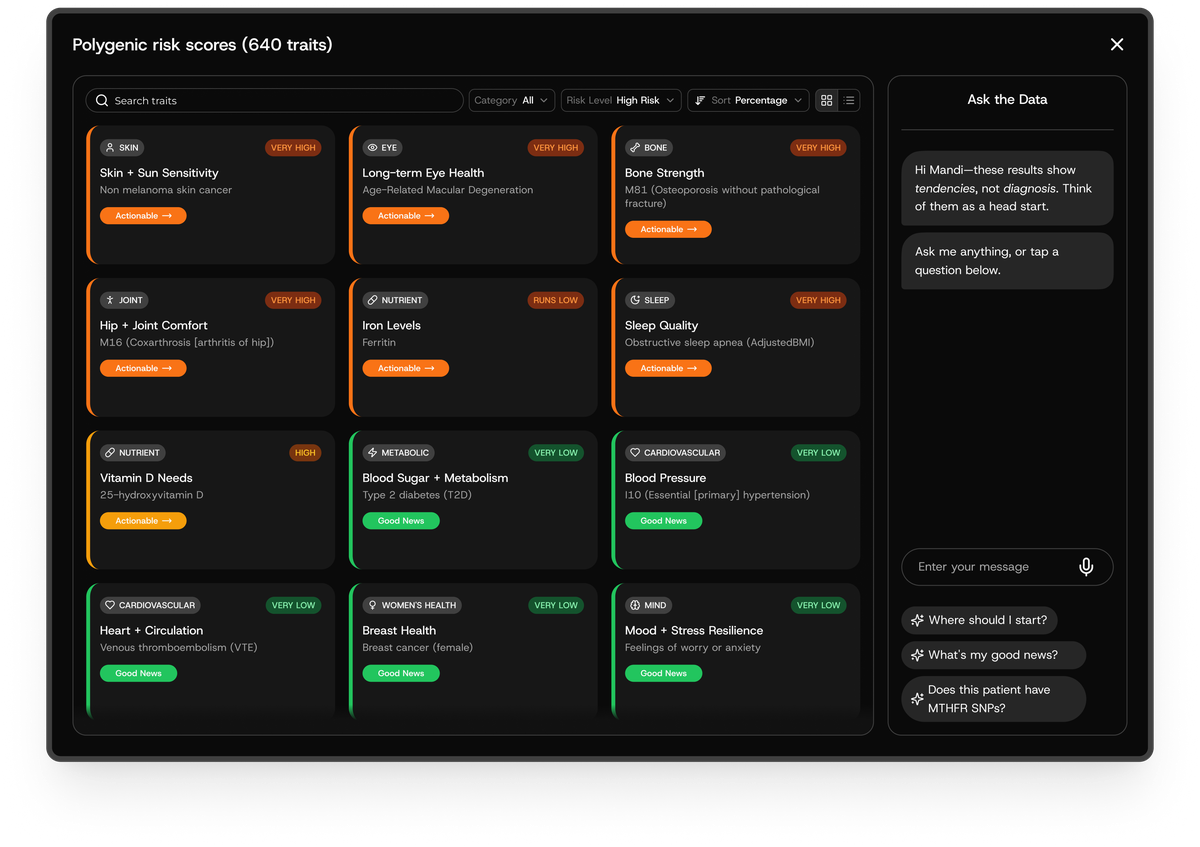
One test. Lifetime insights.
What is whole genome sequencing?
Your genome is the full set of instructions your body is built from. Whole genome sequencing reads all of it, from a saliva sample you collect at home. Your DNA doesn't change, so you only need to do it once.
- High blood pressure
- Atrial fibrillation
- High cholesterol
- Type 2 diabetes
- Insulin resistance
- Response to statins
- Varicose veins
- Gout
- Osteoporosis
- Knee osteoarthritis
- Kidney stones
- Fatty liver disease
- Glaucoma
- Cataracts
- Nearsightedness
- Macular degeneration
- Hearing loss
- Asthma
- Seasonal allergies
- Sleep apnea
- Insomnia
- Migraine
- Short sleep
- Response to beta blockers
- Acne
- Eczema
- Psoriasis
- Hypothyroidism
- Celiac disease
- Acid reflux
- Gallstones
- Iron deficiency anemia
- Vitamin B12 deficiency
- Endometriosis
- Enlarged prostate
- Chronic sinusitis
Examples only. Results are insights to discuss with your provider, not a diagnosis.
- The lab
- Sequenced by a CLIA-certified lab partner
- Your baseline
- Compared with people of similar genetic ancestry
- Medications
- Based on CPIC, DPWG and FDA guidelines
- Inherited variants
- Checked against ClinVar, ClinGen and gnomAD
More DNA, better insight
How is it different from a consumer DNA test?
Most consumer DNA tests read a fixed set of spots scattered across your genome. Whole genome sequencing reads the whole thing, so you and your provider have more to work with.
Profile Health uses whole genome sequencing only and does not accept results from other DNA tests.
What can my DNA tell me about my health?
One genome, four kinds of insight. Your provider walks you through all of it.
01
Inherited variants
Genetic changes linked to inherited conditions, checked against the major clinical databases. Plus the well-known functional variants your provider may already ask about.
How we look for inherited variants
ATGCCGTAGCTAOne change · checked against ClinVar, ClinGen, gnomAD
Rare changes, big effects
Some single changes in your DNA can have a large effect on health. Whole genome sequencing lets us look for them across your entire genome, not just a preset list of spots.
Checked against the evidence
Each change is compared with ClinVar, ClinGen and gnomAD, large research databases that record what is known about a variant, how strong the evidence is and how common it is.
Plus familiar variants
We also report well-known functional variants your provider may already ask about, alongside the rarer ones. Changes whose meaning is still uncertain are set aside, not overstated.
Read by your provider
The report organizes and ranks what is found. It does not make a diagnosis. Your provider reads it with your family and health history and may suggest genetic counseling.
02
Polygenic risk
How thousands of small differences add up across 400 traits, from heart and metabolism to sleep and bones. A higher percentile means a higher genetic tendency, not a diagnosis.
How a polygenic risk score works
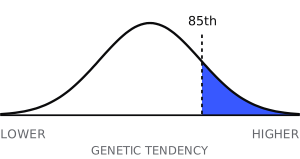
Example scale, not a result. Your percentile is your rank among people of similar ancestry.
Many small effects, added up
Most traits are shaped by thousands of small DNA differences, not one gene. For each of 400 traits we use a published model from the PGS Catalog. Each variant carries a weight, and we add up the ones you carry.
Your percentile, explained
A raw score means little on its own, so we turn it into a percentile. The 85th percentile means your score is higher than about 85 of every 100 people in your comparison group. Higher means a higher genetic tendency, not a diagnosis.
Fitted to your ancestry and sex
Your ancestry is estimated from your genome and used to choose a matched comparison group from the 1000 Genomes Project. Traits that apply to only one sex are shown only when they apply to you.
A science that keeps improving
Newer studies include more diverse people, and many older models came mostly from European ancestry. That is why we calibrate to you and show how much of each model your data covers. Improved models can be applied to the genome you already have.
03
Medication response
How your genes may affect the way your body processes common medications. Talk to your provider before changing any medication.
How medication response works
SLOWERTYPICALFASTERPoor · Intermediate · Normal · Rapid · Ultrarapid
Genes that process medicines
Some genes make the enzymes that break down medicines. Small differences can mean your body processes a drug faster or slower than usual, which can change how it works for you.
From genes to guidance
We read about 25 of these genes, match your versions to known patterns and apply published guidelines from CPIC, DPWG and the FDA. Labels like "poor" or "rapid" describe speed, not health.
Ancestry-aware
Some gene versions are more common in certain populations. Your ancestry, estimated from your genome, is used as an input when your versions are matched to known patterns.
Read against your medicines
Results are compared with the medications you actually take, and your provider reviews them with you. Talk to your provider before you start, stop or change any medication.
04
Nutrition
How your genes may shape the way your body uses nutrients, so food and supplement guidance can fit you instead of the average.
How nutrition insights work
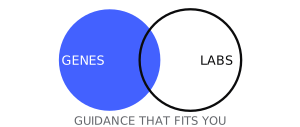
Genes and nutrients
Some genes affect how your body absorbs, converts and uses certain vitamins, fats and other nutrients. Small differences can change what your body needs.
Read with your labs
Genetic tendencies are read alongside your lab results, so guidance reflects both what your genes suggest and what is actually happening in your body right now.
Optimal, sex-adjusted ranges
Your labs are compared with optimal ranges, not just normal ones, and adjusted for sex, so small shifts do not get lost in a wide "normal."
Guidance that fits you
Your provider can use all of this to shape food and supplement choices around you, instead of the average person, and adjust them as your labs change.
The science · Inherited variants
How we look for inherited variants
One change · checked against ClinVar, ClinGen, gnomAD
Rare changes, big effects
Some single changes in your DNA can have a large effect on health. Whole genome sequencing lets us look for them across your entire genome, not just a preset list of spots.
Checked against the evidence
Each change is compared with ClinVar, ClinGen and gnomAD, large research databases that record what is known about a variant, how strong the evidence is and how common it is.
Plus familiar variants
We also report well-known functional variants your provider may already ask about, alongside the rarer ones. Changes whose meaning is still uncertain are set aside, not overstated.
Read by your provider
The report organizes and ranks what is found. It does not make a diagnosis. Your provider reads it with your family and health history and may suggest genetic counseling.
The science · Polygenic risk
How a polygenic risk score works
Example scale, not a result. Your percentile is your rank among people of similar ancestry.
Many small effects, added up
Most traits are shaped by thousands of small DNA differences, not one gene. For each of 400 traits we use a published model from the PGS Catalog. Each variant carries a weight, and we add up the ones you carry.
Your percentile, explained
A raw score means little on its own, so we turn it into a percentile. The 85th percentile means your score is higher than about 85 of every 100 people in your comparison group. Higher means a higher genetic tendency, not a diagnosis.
Fitted to your ancestry and sex
Your ancestry is estimated from your genome and used to choose a matched comparison group from the 1000 Genomes Project. Traits that apply to only one sex are shown only when they apply to you.
A science that keeps improving
Newer studies include more diverse people, and many older models came mostly from European ancestry. That is why we calibrate to you and show how much of each model your data covers. Improved models can be applied to the genome you already have.
The science · Medication response
How medication response works
Poor · Intermediate · Normal · Rapid · Ultrarapid
Genes that process medicines
Some genes make the enzymes that break down medicines. Small differences can mean your body processes a drug faster or slower than usual, which can change how it works for you.
From genes to guidance
We read about 25 of these genes, match your versions to known patterns and apply published guidelines from CPIC, DPWG and the FDA. Labels like "poor" or "rapid" describe speed, not health.
Ancestry-aware
Some gene versions are more common in certain populations. Your ancestry, estimated from your genome, is used as an input when your versions are matched to known patterns.
Read against your medicines
Results are compared with the medications you actually take, and your provider reviews them with you. Talk to your provider before you start, stop or change any medication.
The science · Nutrition
How nutrition insights work
Genes and nutrients
Some genes affect how your body absorbs, converts and uses certain vitamins, fats and other nutrients. Small differences can change what your body needs.
Read with your labs
Genetic tendencies are read alongside your lab results, so guidance reflects both what your genes suggest and what is actually happening in your body right now.
Optimal, sex-adjusted ranges
Your labs are compared with optimal ranges, not just normal ones, and adjusted for sex, so small shifts do not get lost in a wide "normal."
Guidance that fits you
Your provider can use all of this to shape food and supplement choices around you, instead of the average person, and adjust them as your labs change.

Why it matters
Your genome, plus your story.
On its own, DNA is a starting point. Profile Health connects your whole genome with your health history, labs and goals, so your results mean something for you and give you and your provider something to act on.

Once.
Your DNA doesn't change. One test lasts a lifetime.

In context.
Read alongside your records, labs and goals, not on its own.

For you.
Nutrition, medications and plans that can keep adapting to you.
Ask your provider about Profile Health
Ordered by your provider. Results reviewed with your provider.
FAQ
Questions, answered.
Your provider is the best person to ask about your own results.
What is whole genome sequencing?
It reads nearly all of your DNA, about 3 billion letters, from one saliva sample. A typical consumer DNA test reads about 640,000 spots.
What can my DNA tell me about my health?
It can show how your genes may affect things like heart health, metabolism, how you respond to some medications and how your body uses nutrients. Your provider helps you understand what it means for you.
What is a polygenic risk score?
It adds up the small effects of many genetic variants to show whether your inherited risk for a trait may be higher or lower than average. Profile Health scores 400 traits. A score is not a diagnosis; it's something to discuss with your provider.
Can I use results from a consumer DNA test?
No. Profile Health uses whole genome sequencing only, so we need a new saliva sample. The good news: you only do it once.
How do I get started?
Ask your provider about Profile Health. They order your kit and go through your results with you.